







Head Office
141-A, Electronic complex, Pardesipura,Indore - 452010 India
Phone: +91 73899 00887 , +91 98932 70303
Toll Free
+91 73899 00887
Working Hours
We are happy to meet you during our working hours. Please make an appointment.
- Monday-Saturday: 9:00 AM - 5:30 PM (IST)
- Sunday: Closed
Head Office
141-A, Electronic complex, Pardesipura,Indore - 452010 India
Phone: +91 73899 00887 , +91 98932 70303
Toll Free
+91 73899 00887
We are happy to meet you during our working hours. Please make an appointment.
- Monday-Saturday: 9:00 AM - 5:30 PM (IST)
- Sunday: Closed
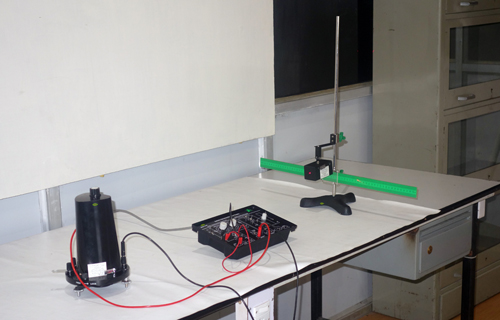
Ballistic Galvanometer Setup
Nvis 6107
Product Description
Nvis 6107 Ballistic Galvanometer Setup illustrates fundamental information about electromagnetic induction. It concerns how electric field affects the magnetic field and also reveals the mechanism of current sensing devices.
The ballistic galvanometer is a highly sensitive instrument used for measuring the quantity of electric charge passing through a circuit. This ballistic galvanometer setup helps students understand electromagnetic induction principles and charge measurement techniques.
Ballistic Galvanometer Setup enables not only the detection of weak electric fields but also measures it very precisely. Ballistic power supply is included with the setup, in which we can generate a very weak ambient electric field and can reveal this effect to the Ballistic Galvanometer as a detected deflection of coil. Lamp and scale arrangement is included for measurement of deflection.
A ballistic galvanometer measures the total charge flowing through the coil by observing the initial deflection, making it an essential instrument in physics laboratories and educational demonstrations.
Nvis 6107, Ballistic Galvanometer Setup is an ideal platform to enhance education, training, skills & development amongst our young minds.
Scope of Learning
- Determination of Ballistic constant by steady deflection method
- Determination of Charge sensitivity of Ballistic Galvanometer using capacitors
- Comparing capacitance of two condensers using Ballistic Galvanometer
- Study the logarithmic decrement for a Ballistic Galvanometer
- Performing a ballistic galvanometer experiment to analyze charge flow and electromagnetic induction phenomena
- Understanding how a ballistic galvanometer measures electric charge and determining instrument sensitivity for laboratory applications
Principle of Ballistic Galvanometer
A ballistic galvanometer works on the principle that when a brief current pulse passes through its coil, the coil experiences a torque and undergoes a momentary angular displacement. The first maximum deflection of the coil is directly proportional to the total quantity of electric charge that flows through it rather than the magnitude of the current itself.
A ballistic galvanometer measures the quantity of charge transferred during a short time interval by observing the initial throw or deflection of the coil. The instrument is designed with a large moment of inertia and a weak restoring torque, allowing the coil to respond accurately to transient currents. This principle forms the basis of many laboratory experiments involving electromagnetic induction, capacitance measurement, and charge determination.
The ballistic galvanometer experiment is commonly used to determine the ballistic constant, compare capacitances of condensers, and study the relationship between induced charge and magnetic flux changes.
Why Choose Nvis 6107 Ballistic Galvanometer Setup?
The Nvis 6107 Ballistic Galvanometer Setup is designed to provide students and educators with a reliable platform for studying electromagnetic induction, charge measurement, and transient current phenomena. Equipped with a highly sensitive ballistic galvanometer, this setup enables accurate observation of coil deflection and helps learners understand the principles behind charge detection and measurement. Whether used for academic demonstrations or laboratory experiments, it offers a practical and engaging way to explore how a ballistic galvanometer measures electric charge and supports a variety of ballistic galvanometer experiment applications.
- Designed to demonstrate the fundamental principles of electromagnetic induction and charge measurement.
- Features a highly sensitive ballistic galvanometer for accurate detection of small quantities of electric charge.
- Complete setup includes power supply, lamp and scale arrangement, and adjustable stand for convenient experimentation.
- Helps students understand how a ballistic galvanometer measures charge through coil deflection.
- Suitable for performing a wide range of ballistic galvanometer experiment activities in physics laboratories.
- Robust construction ensures reliable performance and long service life.
- Ideal for educational institutions, research laboratories, and technical training centers.
- Supports practical learning of ballistic constant determination, charge sensitivity, capacitance comparison, and logarithmic decrement studies.
- Includes online product tutorial for enhanced learning and easier operation.
- Provides a hands-on platform for developing practical skills in electrical and electronics laboratory experiments.
FAQs
What is a ballistic galvanometer?
A ballistic galvanometer is a sensitive measuring instrument used to determine the total quantity of electric charge passing through a circuit. Unlike a conventional galvanometer that measures continuous current, a ballistic galvanometer measures charge by observing the initial deflection of its moving coil.
Why is a ballistic galvanometer called ballistic?
The term “ballistic” refers to the motion of the coil, which behaves similarly to a projectile receiving an impulse. When a short pulse of current passes through the instrument, the coil experiences a sudden movement, and the resulting deflection is used to calculate the amount of charge transferred.
How does a ballistic galvanometer work?
A ballistic galvanometer works by allowing a brief current pulse to pass through a suspended coil placed in a magnetic field. The charge flowing through the coil produces a torque that causes the coil to deflect. The first maximum deflection is proportional to the total charge that has passed through the circuit.
What does a ballistic galvanometer measure?
A ballistic galvanometer measures the quantity of electric charge transferred through a circuit during a short interval of time. It is commonly used in experiments involving electromagnetic induction, capacitance measurements, and determination of magnetic flux changes.
What are the applications of a ballistic galvanometer?
A ballistic galvanometer is widely used in physics and electrical engineering laboratories for determining the ballistic constant, measuring charge sensitivity, comparing capacitances of condensers, studying electromagnetic induction, and analyzing transient electrical phenomena.
- Request Quote
- Technical Specification